Applicable specifications:
AMS7012
Associated specifications:
UNS S17400, AMS5643, ASME SA564, ASTM A564/A564M, ASTM A705, DIN 1.4548 (X5CrNiCuNb17-4-4), DIN 1.4542 (X5CrNiCuNb16-4), AISI 630
Single figures are nominal except where noted.
| Iron |
| Nickel |
| Molybdenum |
| Carbon |
| Phosphorus |
| Tin |
| Balance |
| 3.00–5.00 % |
| 0.50 % |
| 0.070 % |
| 0.040 % |
| 0.020 % |
| Chromium |
| Manganese |
| Niobium + Tantalum |
| Aluminum |
| Nitrogen |
| 15.00–17.50 % |
| 1.00 % |
| 0.15 –0.45 % |
| 0.050 % |
| 0.030 % |
| Copper |
| Silicon |
| Cobalt |
| Oxygen |
| Sulfur |
| 3.00–5.00 % |
| 1.00 % |
| 0.40 % |
| 0.040 % |
| 0.030 % |
PowderRange® 17-4 AR stainless steel is a martensitic precipitation/age-hardening stainless-steel offering high strength and hardness, along with excellent corrosion resistance, up to 600°F (316°C). It has good fabricating characteristics and can be age-hardened by a single-step, low-temperature treatment, which can be chosen to achieve specific strength and toughness combinations. Due to this balanced combination of performance and ease of use in AM, PowderRange® 17-4 AR for additive manufacturing has been used for a wide variety of applications, including rapid tooling functional components in nearly every market, and prototyping.
| Part Number | PowderRange® 174AR F |
|---|---|
| Application | L-PBF1 |
| Maximum Particle Size | Max 1 wt% > 53 µm2 |
| Minimum Particle Size | Max 10 vol% < 15 µm3 |
| LSD Percentile | D10, D50, D903, reported |
| Atomization | Vacuum Induction Melted, Argon Gas Atomized |
| Apparent Density (G/CM3) | Measured according to ASTM B2124 and reported |
| Hall Flow (S/50G) | Measured according to ASTM B2135 and reported |
1ASTM/ISO 52900: Laser—Powder Bed Fusion (L-PBF), Electron-Beam Powder Bed Fusion (EB-PBF), Directed Energy Deposition (DED)
2ASTM B214 Standard Test Method for Sieve Analysis for Metal Powders
3 ASTM B822 Standard Test Method for Particle Size Distribution of Metal Powders and Related Compounds by Light Scattering
4 ASTM B212 Standard Test Method for Apparent Density of Free-Flowing Metal Powders Using the Hall Flowmeter Funnel
5 ASTM B213 Standard Test Method for Flow Rate of Metal Powders Using the Hall Flowmeter Funnel
Testing of powder will fulfill certification requirements to Nadcap Materials Testing and ISO/IEC 17025 Chemical, per relevant ASTM procedures
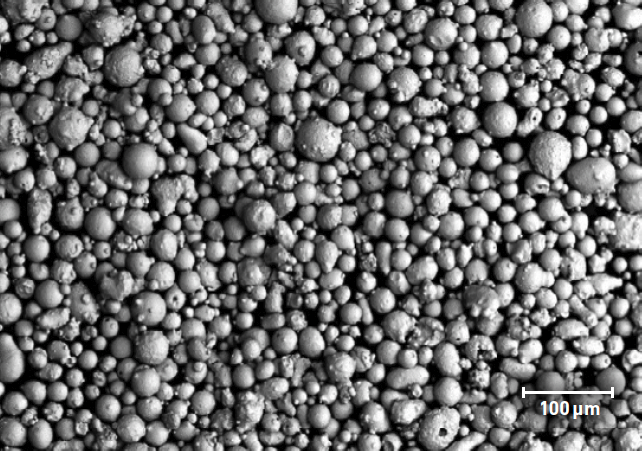
FIGURE 1—SEM IMAGE OF TYPICAL PowderRange 17-4PH AR POWDER
ASTM/ISO 52900: LASER-POWDER BED FUSION (L-PBF)
PowderRange 17-4PH AR is compatible with all commercially available L-PBF equipment.
To achieve mean, as-built density >99.9%, 20 to 60 μm layer thicknesses and Specific Energy ≥ 50 J/mm3 is recommended.
Stress relieve at 1250°F (677°C) for 1 hour per inch of thickness (minimum 2 hours) up to 4 hours.
Carpenter Additive recommends a homogenization treatment at 2000°F (1093°C) for 1 hour followed by an air cool to minimize anisotropy. If performing a HIP step, a separate homogenization treatment is not required.
We recommend HIP as standard practice for microstructure homogenization, removal of residual spatter-induced voids, trapped gas porosity in powder and keyhole porosity, as well as to heal any shrinkage-induced micro-cracks in the material.
To achieve up to full density (100%): Process components under argon at not less than 14.5 ksi (100 MPa) at a temperature of approximately 2087°F (1141°C); hold at the selected temperature for approximately 240 min then cool under inert atmosphere to below 800°F (427°C).
Follow with Solution Anneal and Age treatment as described below
After either homogenization or HIP’ing, Solution Anneal at 1900°F (1038°C) per ASTM A564/A564M for 0.5 hours, cool to below 90°F (32°C) to achieve complete transformation to martensite.
Sections under 3in. (76mm) can be quenched in a suitable liquid quenchant (e.g. water or oil) and sections over 3in. (76mm) should be rapidly air cooled. It is recommended not use this Solution Annealed condition, without age hardening, for the final product due to susceptibility to stress-corrosion cracking.
After Solution Anneal, age material as desired per ASTM A564/A564M, e.g. 900°F (482°C) for 1 hour and air cool.
PowderRange 17-4PH AR is readily machined in both the solution-treated and various age-hardened conditions. In the solution-treated condition, it machines similarly to stainless steel types 302 and 304.
When using carbide tools, surface speed feet/minute (SFPM) can be increased between 2 and 3 times over the highspeed suggestions. Feeds can be increased between 50 and 100%.
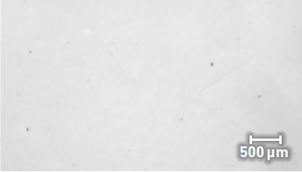
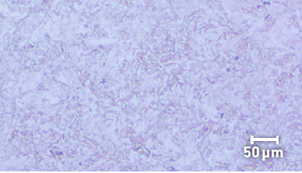
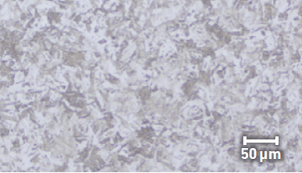
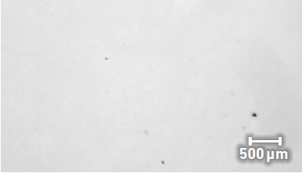
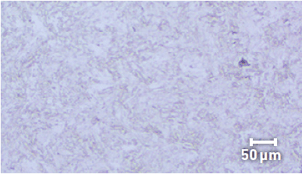
TYPICAL MICROSTRUCTURES
| Condition | Transverse | Longitudinal (Y-Z Plane) | Notes |
|---|---|---|---|
| As-Built |
|
|
Mean densities greater than 99.9% |
| HIP/Sol/Age |
|

|
Up to 100% density |
| As-built, etched6 |
|
|
Typical pre-solutionized PowderRange 17-4PH AR microstructure, consisting of martensite with minimal carbide precipitates |
| HIP/Sol/ H900, etched6 |
|

|
Average grain size ASTM 7-87 |
6 Etched with Ralph’s etchant
7 ASTM E112 Standard Test Method for Determining Average Grain Size
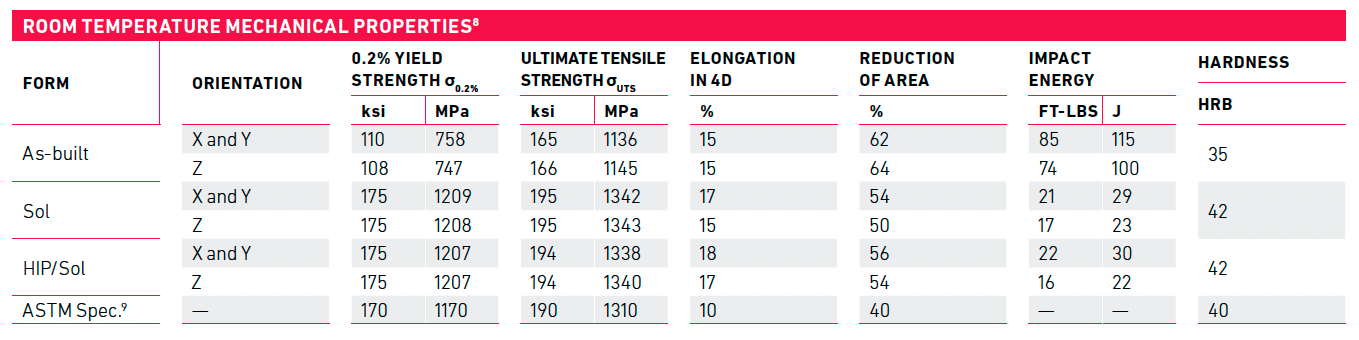
8 Average of a minimum of 5 samples taken from across the extents of a build plate in each orientation and for each heat treatment. Testing performed in accordance with ASTM E8/E8M-16a (tensile), ASTM E23-18 (impact energy), and ASTM E18-19 (hardness). Additional data may be available through a wide range of consortia and other collaborations. Please contact Carpenter Additive for additional information.
9 ASTM A564A564M-13 XM-12 H900 Mechanical Test Requirements after Age Hardening Heat Treatment
IMPORTANT NOTE: The following 4-level rating scale (Excellent, Good, Moderate, Restricted) is intended for comparative purposes only and is derived from experiences with wrought product. Additive manufactured material may perform differently; corrosion testing is recommended. Factors that affect corrosion resistance include temperature, concentration, pH, impurities, aeration, velocity, crevices, deposits, metallurgical condition, stress, surface finish, and dissimilar metal contact.
| Nitric Acid | Good |
| Phosphoric Acid | Restricted |
| Sea Water | Restricted |
| Humidity | Excellent |
| Sodium Hydoxide | Moderate |
| Sulfuric Acid | Restricted |
| Acetic Acid | Moderate |
| Salt Spray (NaCl) | Good |
| Sour Oil/Gas | Moderate |
| Company |
| Other Generic Names |
| 3D Systems |
| GE (Concept Laser) |
| EOS |
| DMG Mori (Realizer) |
| Renishaw |
| SLM Solutions |
| Sulfuric Acid |
| 1.4542, 17-4PH |
| LaserForm 17-4PH |
| 17-4PH |
| GP1 |
| - |
| Stainless Steel 17-4 |
| 17-4PH (1.4542) |
For additional information,
please contact your nearest sales office:
info@carpenteradditive.com | 610 208 2000
The mechanical and physical properties of any additively-manufactured material are strongly dependent on the processing conditions used to produce the final part. Significantly differing properties can be obtained by utilizing different equipment, different process parameters, different build rates and different geometries. The properties listed are intended as a guide only and should not be used as design data.
The information and data presented herein are typical or average values and are not a guarantee of maximum or minimum values. Applications specifically suggested for material described herein are made solely for the purpose of illustration to enable the reader to make his/her own evaluation and are not intended as warranties, either express or implied, of fitness for these or other purposes. There is no representation that the recipient of this literature will receive updated editions as they become available.
Unless otherwise specified, registered trademarks are property of CRS Holdings Inc., a subsidiary of Carpenter Technology Corporation.